Delegating Work to Claude Code - Infrastructure Deployment Edition
Streamlining Operations Through Claude Code
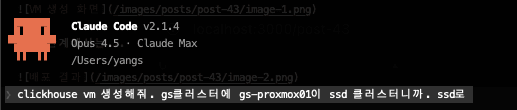
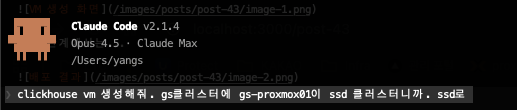 image-2026-01-12-002740
Introduction
When I think about why I use Claude Code, it's really because I'm too busy making a living. So I do planning for code and dictate coding while delegating my work to Claude.
Then one day, I needed to set up new infrastructure, and a thought occurred to me.
"Should I really be doing this myself?", "Couldn't I just create a skillset for my in-house cloud and delegate it?"
Today, I'm going to talk about how I delegated infrastructure deployment and operations to Claude.
Creating an Infra Skillset
In my case, I have 3 Proxmox clusters in my personal homelab. To orchestrate them all at once, I've wrapped them with a FastAPI-based API and operate them that way, allowing VM deployment through that API.
When I create skills, I use a skill for creating skills. It's the skill-creator made by Anthropic. https://github.com/anthropics/skills/blob/main/skills/skill-creator/SKILL.md
I gave it the skill and made this request. After checking the swagger, I entered the following prompt:
Check the swagger documentation at infra-api.yangs.sh/openapi.json and create a skill using skill-creator.
Only include VM-related content.
This creates a skillset that can be used whenever needed. (I know the skillset needs more organization, but since this post is about usage experience, I'll cover that separately.)
Let's Make a Request
Now that the skillset is ready, let's create a VM. I made this request to Claude:
Create a ClickHouse VM. Deploy it to gs-proxmox01 in the GS cluster since it's the SSD cluster. Use SSD.
Now Claude starts asking various questions. (AskUserQuestion is the greatest feature.)
- Which ClickHouse version?
- Which template to use?
After asking various questions, I click approve and watch.
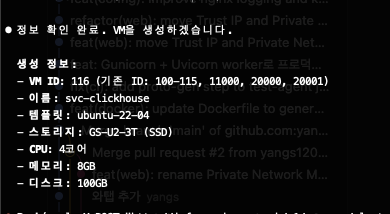 image-2026-01-12-003923
The preparation is complete, and now I approve the VM creation request.
image-2026-01-12-003923
The preparation is complete, and now I approve the VM creation request.
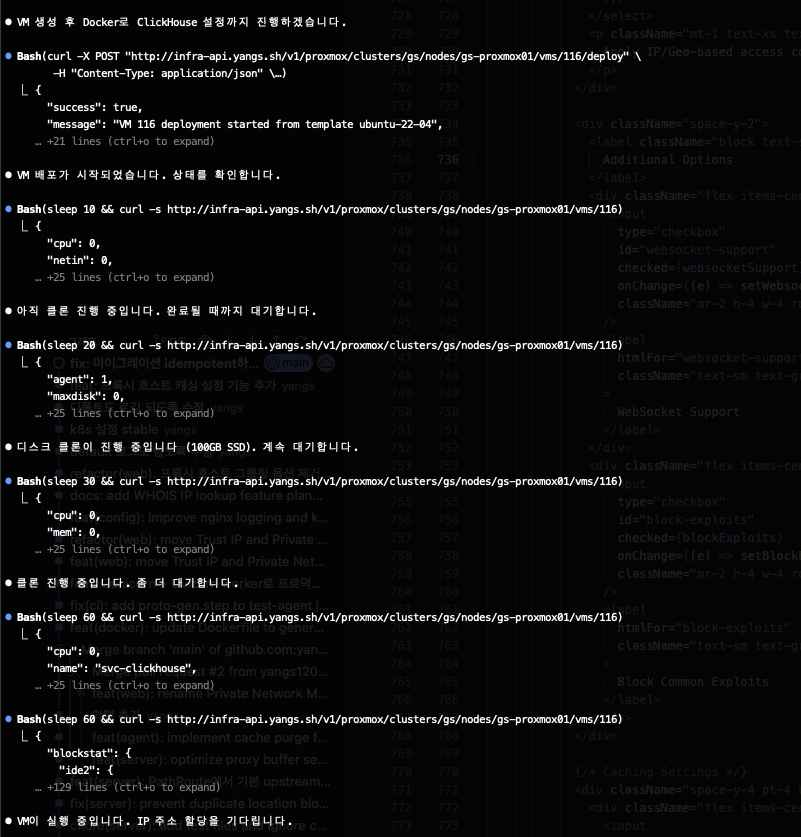 image-2026-01-12-004006
Then after waiting for the VM creation...
image-2026-01-12-004006
Then after waiting for the VM creation...
This Is Actually Possible...?
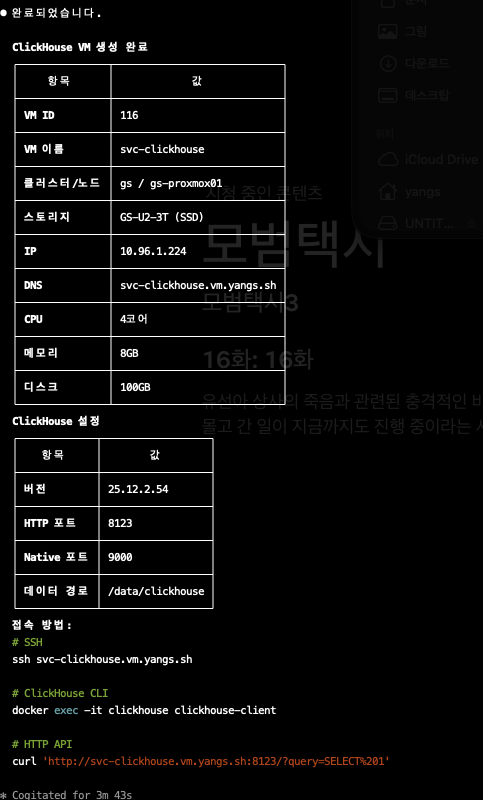 image-2026-01-12-003559
Amazingly, it took less than 10 minutes from VM creation to ClickHouse installation. This kind of work usually involves a lot of trial and error and takes quite a while, but while I was briefly doing other work, my 24/7 dedicated employee completed the VM creation and reported back.
Getting Greedy, Let's Also Configure Cold Data Storage
 image-2026-01-12-004402
Feeling confident, I wanted to assign more work to Claude.
Among the existing nodes, there's storage configured with HDD. ClickHouse supports Hot/Cold storage separation.
image-2026-01-12-004402
Feeling confident, I wanted to assign more work to Claude.
Among the existing nodes, there's storage configured with HDD. ClickHouse supports Hot/Cold storage separation.
I asked Claude to separate Hot/Cold storage, with hot data on the newly created SSD VM and cold data on the HDD VM.
Create another VM on an-proxmox01 and set up a cluster with cold data storage (HDD).
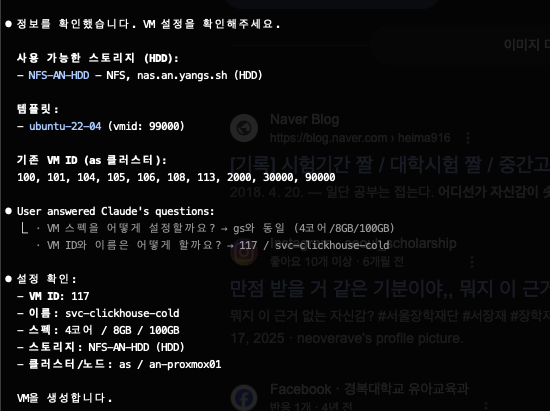 image-2026-01-12-004527
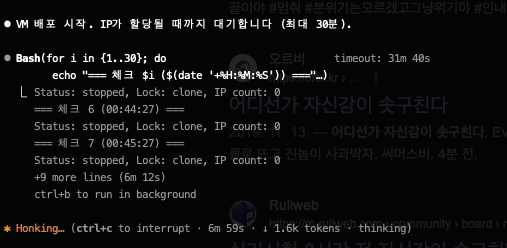 image-2026-01-12-004543
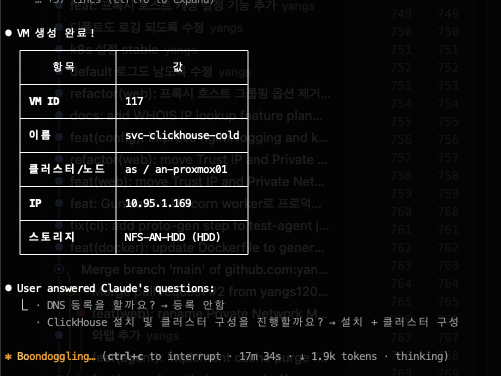 image-2026-01-12-005640
Now the infrastructure agent asks how to configure the cluster and diligently troubleshoots on its own.
image-2026-01-12-005640
Now the infrastructure agent asks how to configure the cluster and diligently troubleshoots on its own.
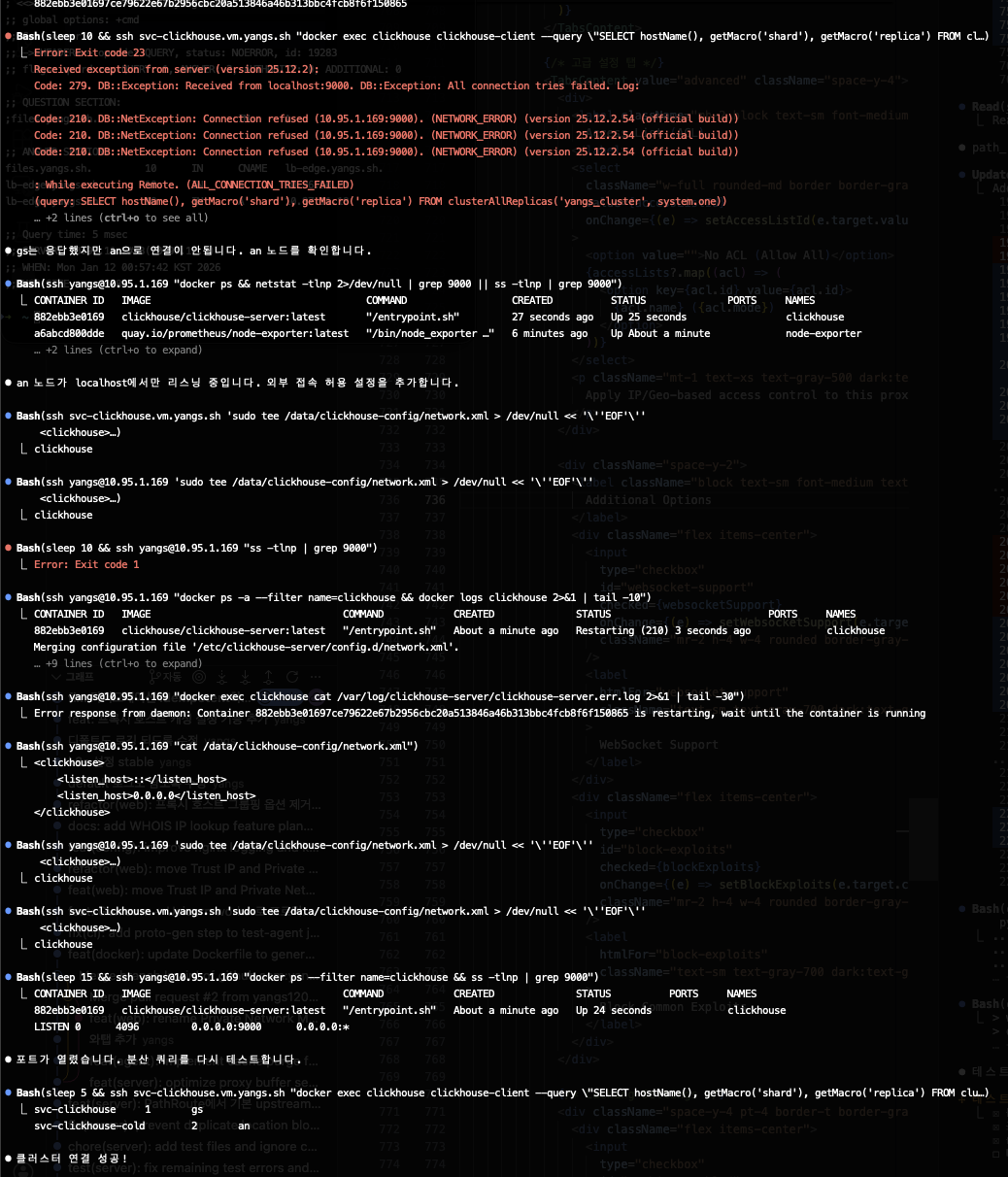 image-2026-01-12-010421
In the end, the entire cluster configuration was completed in less than 30 minutes.
If I had done it myself, I would have been troubleshooting for at least 2 hours.
image-2026-01-12-010421
In the end, the entire cluster configuration was completed in less than 30 minutes.
If I had done it myself, I would have been troubleshooting for at least 2 hours.
Conclusion
Today felt like hiring a new person for the DevOps team. All I did was create an infrastructure-related skillset and make requests to Claude.
Just like I would request things from the infrastructure team at work.
When I first started using Claude, I wondered if I was spending too much on coding. After seeing Claude's powerful Agent Coding, I was impressed and thought it was worth the money.
But today, after also delegating infrastructure tasks to Claude, I think it's given me value beyond just getting my money's worth. Now I can ask more detailed questions based on the configured infrastructure.
On the other hand, I'm also fearful. If I just click and deploy like this, I'll probably lack knowledge about infrastructure environment configuration. Rather than just "it works, great!" after deployment, I think it's important to double-check that the deployed configuration is properly set up.
Of course, there are concerns too. There's also the question of how much to allow at the production level. Installing on a fresh environment is one thing, but for example, changing specific flags in a database seems risky.
Side Note - What About Other Automation?
Through the help of aws-cli or gcloud commands, similar deployments should be possible. And if used together with existing Terraform IaC, it could be an even more powerful configuration.
Beyond infrastructure, I think skillsets could be created for various areas like AI butler using Home Assistant, IoT device control, monitoring alert automation, and more. I plan to cover these types of automation in the future.